

OFFICIAL SBS MARKETING PARTNER
ON AIR,OUR WAY.
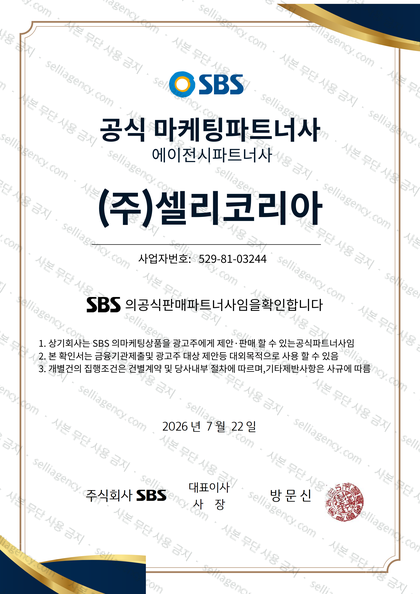 View the official certificate
A PPL agency sells you a slot. We bring back a plan.
SELLi (셀리) is an official SBS marketing partner. Most placement agencies buy a slot that already exists and resell it. We receive the network’s new programming and ad line-up first each month, brief SBS on the brand’s category, budget and direction, and SBS’s senior marketing line designs an IMC plan for that brand specifically. Below is what a placement agency actually does, how to verify one before you pay, and exactly what SELLi has and has not delivered.

- 01 · Brief the direction
- We meet the SBS team directly to set budget and direction, and take the exposure the advertiser wants straight to the producer so it lands as intended rather than getting buried.
- 02 · SBS designs the strategy
- Every month the new line-up is analysed and a bespoke IMC is drawn up. Not a slot assignment: the network’s strategy arrives first.
- 03 · Collect the plan
- Drama and variety placement, radio jingles and YouTube short-form are executed as a single campaign.
- Case · SBS drama Kim Bujang
- A charcoal-grill franchise was written into the drama as the cast’s dinner spot, alongside a dedicated radio jingle and SBS YouTube short-form across three months. Not one appearance, but a campaign linking broadcast, radio and short-form.
What a placement agency actually does
Product placement and programme sponsorship get talked about as one thing, but they are different products. Placement (간접광고) puts the product inside the scene. Sponsorship funds the production or supplies goods and credits the brand in a caption at the end of the programme. They sit on different articles of the statute and they price differently. Placement is defined by Broadcasting Act article 73(2)7 and conditioned by Enforcement Decree article 59-3. The statute text and a product-by-product comparison are in Placement and sponsorship rules.
The work itself splits into the six parts below. How much of it an agency does in-house is what actually varies between agencies, and it is where most of the difference between two quotes for the same programme comes from. Ask all six and the answers become comparable.
- Media access
- Which broadcaster, and which programmes within it. Terrestrial broadcast advertising is sold through a licensed advertising sales representative under the Broadcast Advertising Sales Agency Act. What relationship an agency holds with the network, and in what form, therefore sets the range of programmes it can put in front of you at all.
- Planning
- Translating a budget and a category into a programme and an exposure level. The same money spent on one prop appearance in a drama, a scripted use in a variety show, or a radio jingle produces completely different outcomes. Published price bands by level, and how a rate is derived, are in What placement costs.
- On-set execution
- How the brand is written into the script, when and how the props are delivered, who is actually on set on the shoot day. Whether the exposure agreed in the proposal survives into the finished cut is decided here. This is the single widest gap between an agency that shows up and one that subcontracts it.
- Compliance
- Pushing for the biggest and longest exposure possible is a bad trade: if it fails review the scene is cut and the campaign goes with it. The skill is designing the optimum that passes, not the maximum. Real sanction cases and the articles applied are in the rules page.
- Reporting
- After air, ask whether you receive a written record of which scenes ran, for how long and how many times, and whether the caption carried the exact brand wording agreed. If the delivery date for that report is not in the contract, it usually does not arrive.
- Secondary usage
- Exposure that ends with the domestic airing and exposure that plays again overseas are different products. Whether Netflix and VIU simulcast and overseas reuse rights are included is fixed at contract, and it is rarely possible to add afterwards.
How to choose a placement agency: what you can check before you pay
Impersonation in this category is real and it is documented. Media Today reported in 2007 that a sponsorship agency put the SBS logo on its business cards and contracts, hung an SBS Partners sign at its office door, and asked small companies for between 8 million and 50 million won in exchange for an appearance on air. (Media Today, 5 July 2007) The case is nearly twenty years old and the method has not changed.
The six checks below are the ones a brand can run on its own, before any money moves, without the agency’s cooperation. Run them on SELLi too.
- 01 · Get the business registration number and look it up yourself
- Ask for the contracting entity’s registered name and business registration number in writing, then check its status directly on Hometax, the National Tax Service portal, and read the corporate registry at the Internet Registry Office to confirm the representative and the registered address match the proposal. Check at the same time that the contracting entity, the tax-invoice issuer and the bank account holder are all the same name. SELLi’s business registration number is 529-81-03244 and it is printed at the foot of every page of this site.
- 02 · Ask what the relationship with the broadcaster is, in writing
- "We work with SBS" is not a verifiable statement. Ask to see the physical certificate or partner document the broadcaster issued, and check the issuer, the issue date and the seal. SELLi publishes its SBS official marketing partner certificate unretouched on the certificate page.
- 03 · Get the placement confirmed in writing before you pay
- The most dangerous pattern is an up-front payment with no written confirmation of which programme and what form of exposure you are buying. The programme, the exposure level, the expected airing, what happens if the episode is pulled, cut or rescheduled, and when the report arrives all belong in the contract. The clauses to check are listed in How a sponsorship runs.
- 04 · Know that terrestrial placement cannot be sold by just anyone
- Article 5(1) of the Broadcast Advertising Sales Agency Act bars terrestrial broadcasters and general programming channels from carrying advertising other than that consigned by a licensed sales representative, and article 40 punishes operating as one without a licence with up to three years’ imprisonment or a fine of up to 50 million won. Article 73(8) of the Broadcasting Act extends the same consignment requirement to placement sold in independently produced programmes scheduled on terrestrial channels. The list of licensed sales representatives is published by the Korea Media and Communications Commission, so a brand can check it directly.
- 05 · Ask what the price is based on
- The split is between "that programme costs X" and a published rate. The Korea Broadcast Advertising Corporation has stated on its own public board that no placement rate card exists and that the price moves monthly with ratings and exposure level, which makes the broadcaster’s published rate the reference. SELLi republishes the SBS rate programme by programme every month in the rate list.
- 06 · See whether they raise the failure clause first
- Episodes get pulled, scenes get cut entirely, schedules move. A good agency explains what happens then before the brand asks. An agency that defers the clause or waves it away with "that does not happen" is telling you it will not take written responsibility when it does.
The SBS programmes SELLi has actually delivered
This is the most important distinction on the page. Below is what SELLi has actually run on SBS, and it is the whole list. The rate list we publish carries 26 programmes, but being on a rate card means it is brokerable inventory, not that it is past work. Where an agency’s deck blurs those two, split the question and ask again.
Brand names are withheld at the advertisers’ request and shown as categories only. The categories delivered across 런닝맨, 자식 방생 프로젝트 합숙 맞선 2, 재벌 X 형사 II and 두시탈출 컬투쇼 are small home appliances, beauty and F&B, stated collectively rather than broken out programme by programme. Programme titles are given in Korean where no official English title exists, rather than translated here. Air periods are printed only where they are confirmed, so they are left out.
- SBS Fri-Sat drama Kim Bujang (김부장) · F&B
- A charcoal-grill franchise was written into the drama as the cast’s dinner spot, alongside a dedicated radio jingle and SBS official YouTube short-form, run as one campaign across three months. The brand is not disclosed.
- SBS variety Running Man (런닝맨)
- Broadcast exposure carried into SBS official YouTube short-form to extend it into digital reach.
- SBS variety 자식 방생 프로젝트 합숙 맞선 2
- Brand exposure, sponsorship and set placement run together.
- SBS drama 재벌 X 형사 II
- Delivered as scene-integrated placement.
- SBS radio 두시탈출 컬투쇼
- A jingle, a branded segment and a listener event. Power FM scheduling and how radio products are structured are covered in SBS radio advertising.
- What we do not do
- We do not propose what the law forbids. Enforcement Decree article 59-3(1) allows placement only in cultural or entertainment programming and excludes programmes aimed at children and news, current affairs, commentary and debate. Paragraph (2) prohibits placement of products whose broadcast advertising is barred by other legislation or by the review regulation; alcohol falls here. A proposal offering you one of those slots ends the verification on the spot.
The five things to demand before you sign
These are the five questions a brand should actually put to a placement agency. SELLi’s answers are written out below so you can check them before contacting us. Ask the same five of anyone else you are considering, in writing, and the proposals become comparable.
- 01 · Track record: which programme, which brand
- Published programme by programme in the section above. Brand names are shown as categories at the advertisers’ request. Air periods are printed only where confirmed, so they are currently omitted. Be wary of a deck that skips this distinction and presents a rate-card programme list as delivered work.
- 02 · Direct contract or subcontract
- What the brand is really asking is how many layers of margin it is paying. SELLi contracts the advertiser directly and executes the placement itself. There is no second agency sitting between the brand and SELLi taking another fee. That the contracting entity and the tax-invoice issuer are both SELLi KOREA Co., Ltd. (business registration 529-81-03244) is visible on the contract itself.
- 03 · What is guaranteed: exposure level and episode count
- Price is set by exposure level. A prop appearance puts the product in frame; a scripted use has the cast actually using it, or sets the brand as an occupation within the story. Which level, in how many episodes, and in what scene form is fixed in writing before the campaign starts. The ceiling on any guarantee is set by law, not by the agency: Decree article 59-3(4) caps the product at one quarter of the screen and prohibits the cast from mentioning the product or recommending its purchase or use. An agency promising you a line of dialogue explaining the product is promising something no one can deliver. The statute text is on the rules page.
- 04 · Secondary usage: how far can the footage travel
- Whether the broadcast footage can be reused on the brand’s own social channels and in paid media, for how long and in which territories, is set at contract. SELLi holds overseas secondary usage rights for broadcast content, including Netflix and VIU simulcast and reach across 16+ Southeast Asian markets; the scope is set out on the overseas rights page. What is not included, stated plainly: unlimited use of the original broadcast master, and use of a performer’s likeness in separate advertising, do not come with secondary usage rights. Performer likeness requires its own agreement.
- 05 · Reporting: what arrives after air
- Broadcast captures, an exposure report and clip files. The report covers which episode carried what form of exposure and how many times, and whether the caption ran with the exact brand wording agreed. If the report delivery date is not written into the contract it usually does not arrive, so put that clause in whoever you work with.
Buying a slot versus bringing back a plan
Two campaigns in the same programme at the same level can land completely differently, and the reason is the order of the design rather than the size of the exposure. Buy the slot first and the brand gets fitted into a decision already made. Get the plan first and the programme and the exposure form follow the message the brand wanted to land.
What a brand gets from SELLi is not one cell chosen off a rate card but a single plan running from drama and variety placement through radio jingles and SBS official YouTube short-form to overseas reuse. That is how the Kim Bujang campaign ran for three months, and it is what this company sells.
Frequently asked
- How does SBS product placement work?
- It runs as a project-based broadcast campaign. Tell us the budget and the direction, and we design the execution plan together with SBS staff, either at your office or at SBS.
- How is the cost decided?
- There is no rate card. It depends on the programme’s ratings and slot, the type of exposure (scripted placement, prop appearance, caption), how many airings, and whether overseas secondary rights are included. We quote per brand after a consultation.
- Can smaller brands do this?
- Yes. Because the programme and exposure type are designed around the budget, a campaign can lead with radio jingles or YouTube short-form instead of drama placement.
- How should I choose a placement agency?
- Ask whether they resell slots or design with the network, then run the checks yourself: business registration lookup, the physical certificate the broadcaster issued, written confirmation of the placement before payment, what the price is based on, and the clause covering a pulled or cut episode. The six checks are set out on this page and the statutory basis is on the rules page.
- What is the difference between sponsorship and product placement?
- Sponsorship funds production or supplies goods and credits the brand in a caption at the end of the programme; placement puts the product inside the scene. We design both as one campaign together with radio and short-form.
- Do I have to go through an agency at all?
- Terrestrial broadcast advertising is sold through a licensed advertising sales representative under the Broadcast Advertising Sales Agency Act. Article 5(1) bars terrestrial broadcasters and general programming channels from carrying advertising other than that consigned by a licensed representative, so paying a production team directly for a placement is not a structure that exists. What an agency does is design and execute within that structure.
- What is the agency fee?
- Part of the commission structure is set by law. Article 5 of the notice on consignment of placement sales by independent producers requires an independent producer to pay the sales representative between 13% and 19% of the placement sale, and requires the representative to pass between 70% and 86% of that consignment fee on to the advertising agency. That is the structural reason an agency quote is never exactly the broadcaster’s published rate. When you take a quote, ask for the total spend and what it covers on one page, and get any separately billed items confirmed in writing.
- What is the minimum budget?
- It depends entirely on the product. On published evidence, the KBS 2024 sales guide puts a level 1 prop appearance at 10 to 20 million won per episode and a level 2 scripted use at 20 to 50 million won, and the SBS published rate for grade 2 placement runs from 15 million to 100 million won. If drama placement is out of range, radio spots, a jingle and short-form will do more with the same money. The bands and their sources are all published on the cost page.
- How far in advance should I enquire?
- Four to eight weeks before air leaves you with options. Writing a brand into a drama script wants eight to twelve. Radio spots and sponsorship can still be done inside two to three weeks, but a radio jingle takes four to six weeks just to produce. Broadcast ad products are published monthly and the good slots in popular programmes close first, so lead time does not buy you a better price; it buys you the number of choices you get. The stage-by-stage schedule is in How a sponsorship runs.
Considering broadcast placement? Tell us the budget and the direction.
Start a project